
DEPOK, April 9, 2026 – The Indonesian Biotechnology Consortium (KBI) and the Research Centre for Biomass Valorization Universitas Indonesia (RCBV-UI) successfully concluded a national Focus Group Discussion (FGD) entitled “Scoping Study on Engineering Biology in ASEAN”. This initiative is an integral part of a regional study supported by the UK Government’s Foreign, Commonwealth and Development Office (FCDO), aimed at mapping the readiness and policy direction of Engineering Biology (EB) across Southeast Asia.
The study was conducted through a collaboration between Universiti Putra Malaysia (UPM) as the regional coordinator and RCBV-UI as the official country representative for Indonesia. The FCDO-UK initiative is driven by the global recognition of Engineering Biology as a transformative technology capable of addressing food security, energy transition, and environmental sustainability challenges. Through this study, Indonesia aims to align its vast biological resources with global innovation standards.

Methodology and Multi-Stakeholder Participation
The Indonesian assessment was conducted in two structured stages: a Key Informant Survey (KIS) with high-level policymakers and a multi-stakeholder FGD. The event was attended by 27 selected experts representing the four pillars of innovation:
- Government: Including representatives from the Ministry of Higher Education, Science, and Technology, and BRIN.
- Academia/Research: Experts from leading universities such as UI, ITB, IPB, and UGM.
- Industry: Representatives from the biopharmaceutical, energy, and agribusiness sectors.
- Funding Agencies: Organizations like BPDP Sawit, which play a crucial role in research downstreaming.
Key Findings: Immense Potential Amidst Fragmentation
The study report reveals that while Indonesia possesses a significant comparative advantage in mega-biodiversity and abundant biomass, the current EB ecosystem is “emerging but fragmented”. Key critical points from the discussion include:
- Conceptual Ambiguity: The absence of a formal definition for Engineering Biology within national policy frameworks leads to inconsistent coordination across various agencies.
- National Priority Sectors: There was a strong consensus to focus development on three primary sectors: Food and Agriculture (biopesticides, crop improvement), Energy and Bio-based Fuels (bioethanol, biomass conversion), and Environment (waste-to-value processes).
- Research-to-Industry Gap: A persistent “Valley of Death” was identified, where laboratory research fails to reach industrial scale due to a lack of pilot-scale facilities and market-oriented funding mechanisms.
Policy Recommendations and Strategic Actions
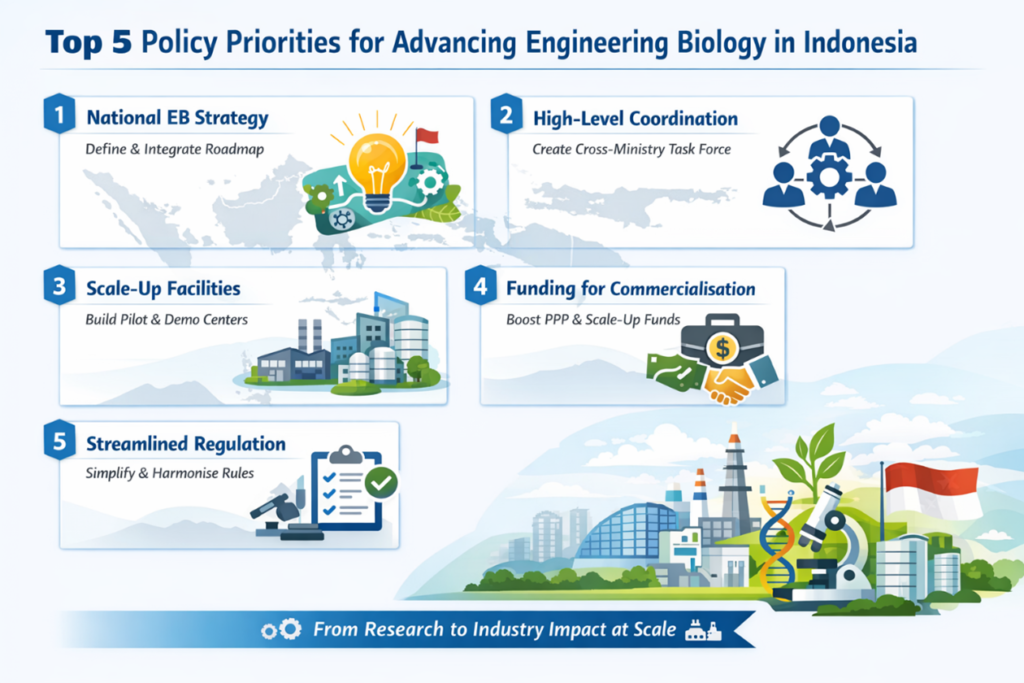
The FGD formulated several strategic policy recommendations to be compiled into the Indonesia Country Policy Brief:
- National EB Strategy: Urgent need for a national roadmap integrated with the National Industrial Development Master Plan (RIPIN 2025–2045).
- Scale-up Facilities: Development of shared infrastructure accessible to both researchers and industry to validate technologies at the pilot scale.
- Funding Reform: Encouraging Public-Private Partnership (PPP) schemes and incentives for private sector investment in high-risk technologies.
- Industry-Ready Talent: Aligning higher education curricula to integrate molecular biology with engineering principles and Artificial Intelligence (AI).
- Regulatory Efficiency and Adaptability: Harmonizing regulatory frameworks and streamlining licensing across agencies to accommodate emerging technologies while strengthening public trust in biosafety and ethical standards.
As a strategic partner, KBI is committed to bridging the gap between research and industry to ensure that biological innovations deliver tangible economic benefits. The insights from this FGD will contribute to the Indonesia Country Policy Brief, which will inform regional strategies across ASEAN.